

Gas Fireplaces: Single-Sided, Corner and Three-Sided Models

Choose your format
Seven direct-vent gas fireplaces with frameless double glass and a flame that rises from the logs, not from behind them. From a compact traditional format to a 60-inch linear view, from a wraparound corner to a three-sided room divider — each one designed, tested and built in Bissendorf, Germany.

Single-Sided

Corner (two-sided)
Three-Sided
Our Gas Fireplaces
Single-Sided

Lina G 60-19 · 60-inch linear
Lina G 42-34 · 42-inch
Lina G 42-34 · 42-inch
Lina G 42-34 · 42-inch
Corner
Lina G 60-19 · 60-inch linear
Lina G 42-34 · 42-inch
Three-Sided
Lina G 60-19 · 60-inch linear
Compare all models
All figures are from the current data sheets (natural gas unless stated). Efficiency is measured to CSA P.4.1-2021. Propane figures and full dimensions are on each model page and in the data sheet.
| Model | Format | Viewing area | Input, natural gas | Input, propane | Efficiency NG / LP | Installed weight | Convection air in / out |
|---|---|---|---|---|---|---|---|
| Lina G 30-24 | Single-sided, traditional | 29 × 23 in | 12,000–24,930 BTU/h | 10,250–22,880 BTU/h | 71.7 % / 72.8 % | 420 lbs | 110 / 165 in² |
| Lina G 36-28 | Single-sided, traditional | [PLATZHALTER] | 12,150–28,350 BTU/h | 10,250–25,275 BTU/h | 70.9 % / 72.7 % | [PLATZHALTER] | 110 / 165 in² |
| Lina G 42-34 | Single-sided, traditional | 42 × 34 in | 19,000–36,850 BTU/h | 17,060–34,120 BTU/h | 68.3 % / 71.4 % | 617 lbs | 110 / 165 in² |
| Lina G 60-19 | Single-sided, linear | 56 × 17 in | 20,800–43,500 BTU/h | 15,400–35,600 BTU/h | 67.7 % / 69.8 % | 585 lbs | 160 / 240 in² |
| Ekko G L 60/14-19 | Corner left, two-sided | 58 × 19 in [prüfen] | 20,800–43,500 BTU/h | 15,400–35,600 BTU/h | 67.7 % / 69.8 % | ≈ 595 lbs [prüfen] | 160 / 240 in² |
| Ekko G R 60/14-19 | Corner right, two-sided | 58 × 19 in | 20,800–43,500 BTU/h | 15,400–35,600 BTU/h | 67.7 % / 69.8 % | 595 lbs | 160 / 240 in² |
| Ekko G U 60/14-19 | Three-sided | 60 × 19 in | 20,800–43,500 BTU/h | 15,400–35,600 BTU/h | 67.7 % / 69.8 % | 606 lbs | 160 / 240 in² |
What every Camina & Schmid fireplace shares
Linear
Corner
3-sided
Square
Options and accessories
- Interior lining
anthracite matte as standard, black ceramic glass (gloss) as an option that mirrors the flame. - Ceramic logs
oak or birch, hand-painted, with Fecralloy® burner fibers. - Ember-bed lighting
LED glow beneath the logs; included with every model. - Moonlight feature
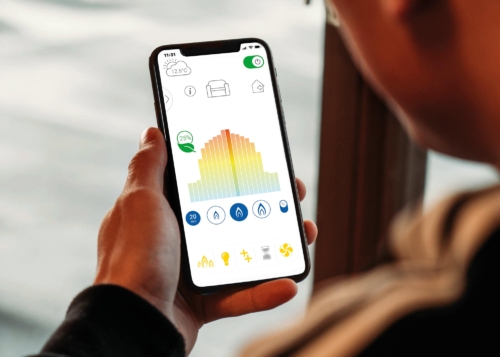
colored (RGB) or white ambient light in the firebox, app-controlled. [Verfügbarkeit je Modell klären: 30-24 laut Datenblatt ohne; 42-34 nur Weiß] - Fire Connects app
optional Wi-Fi module, can be factory-installed. - Wall switch
on/off, flame height and second burner without the remote.
Flame simulator

Built in, not dropped in
A built-in gas fireplace is framed into the wall structure during construction or renovation, with its venting routed through the framing to an exterior wall or the roof. It is not the same as an insert, which fits into an existing masonry opening, and not the same as a freestanding stove.
We build only built-in appliances. That constraint is deliberate: it is what allows the frameless glass, the flush finish, and the flexibility to place a fireplace on a wall that has never had a hearth. It also means the specification decision usually happens early — at framing, not at furnishing — which is why our dealers work directly with builders and architects rather than only at the point of sale.
If you are converting an existing masonry fireplace, an insert from another manufacturer is the right product, and any of our dealers will tell you so.
How we build the flame
Flame-out-of-log presentation
Most gas fireplaces place the burner beneath a decorative log set and pass the flame over it. Our burners route gas through the log geometry itself, so the fire emerges from within the wood. The flame has depth and irregularity rather than the uniform row of jets that gives many gas appliances away at a glance.
Second burner function
An independently controlled second burner nearly doubles the range between minimum and maximum output. Paired with ECO mode, it separates appearance from heat: a full flame picture at low output in October, full heat in January.
Safety architecture
A double glass barrier — heat-resistant reflective inner pane, safety glass outer pane. Double flame guard. Oversized pressure relief valves. Protective cross-lighting and minimal start-up energy. All models are certified to [CSA / ANSI Z21.50] for the United States and Canada.
Made in Germany
Burner development, combustion testing, and final assembly happen in our own facility. The North American range is derived from twenty-five years of building fireplaces for the European market, adapted to North American gas supply, venting practice, and certification.
Natural gas or propane
Every model is available in a natural gas or a liquid propane configuration. Both deliver the same flame picture; the difference is in orifice sizing and regulator setup inside the appliance.
The choice is usually made for you by what is available at the property. If a natural gas line already serves the house, that is almost always the cheaper and simpler option — no tank, no deliveries, no storage. Propane is the standard answer where there is no gas main, and it carries a higher energy density per unit volume, which means a slightly different burn characteristic at the same rated input.
One thing to plan for: the configuration is specified at order and is not a field conversion. If there is any chance the property will switch fuel sources, discuss it with your dealer before the order goes in.
Frequently Asked Questions
All our models are sealed direct-vent appliances. Combustion air is drawn from outside and exhaust leaves through the same 5 × 8 in coaxial vent, terminated through an exterior wall or the roof. Room air is not used for combustion.
Every model ships set up for natural gas. A certified conversion kit, fitted by a qualified installer, converts it to propane. Input and efficiency figures for both fuels are in the comparison table above.
Yes. The control unit and the lighting need a permanent, unswitched 120 V AC supply. Battery operation of the controls is possible but not recommended.
Yes, with conditions. A recessed TV must sit at least 20 in above the top of the glass (21 in for the Lina G 42-34) and be recessed no more than 4 in; a TV mounted on the surface sits in an airflow about 18 °F above room temperature. Each installation manual has the drawings.
Camina & Schmid fireplaces are sold and installed through authorized dealers in the U.S. and Canada. Use the dealer page to find a showroom or contact our distributors, Monsma (U.S.) and The Foundry (Canada).
A limited lifetime warranty on the firebox for the original owner at the original location, two years on gas and electrical components and on thermal breakage of the heat-resistant glass, and one year on the remote and paint. Registration within 90 days and annual service by an authorized dealer are required.